Table of Contents
Search has changed dramatically in the past few years. For decades, businesses focused on Search Engine Optimisation (SEO) to appear higher in search results.
The strategy was simple:
Rank higher → get more clicks → generate more leads.
But today, search engines and AI tools are evolving into something different. Instead of simply listing websites, they now generate answers.
This shift has introduced two new concepts:
- Answer Engine Optimisation (AEO)
- Generative Engine Optimisation (GEO)
Together with SEO, these strategies define how businesses remain visible in modern search.
This guide explains:
- What SEO, AEO and GEO mean
- How AI search works
- Why traditional SEO alone is no longer enough
- How to optimise your website for AI discovery
- Practical strategies businesses can implement today
The Evolution of Search
To understand the importance of SEO, AEO and GEO, we need to look at how search behaviour has evolved.
Phase 1: Traditional Search Engines
Early search engines worked like a directory of websites.
You typed a keyword such as:
“AI company Malaysia”
The search engine returned a list of websites ranked according to relevance. Businesses competed to rank higher through SEO. If your website appeared on page one, you received more traffic.
Phase 2: Answer Engines
Search engines eventually realised users wanted faster answers. Instead of clicking multiple links, people wanted quick explanations.
Search engines began displaying:
- featured snippets
- knowledge panels
- direct answers
Example search:
“What is SEO?”
Instead of clicking a website, users may immediately see a definition at the top of the page. This behaviour led to the concept of Answer Engine Optimisation.
Learn more here.
Phase 3: Generative AI Search
The latest shift is powered by artificial intelligence. AI tools no longer just extract one answer from a page. They analyse multiple sources and generate a summary.
Examples include:
• AI chat tools
• AI search assistants
• AI generated search results
Instead of listing links, these systems create a response that synthesises information from many websites. This is where Generative Engine Optimisation (GEO) becomes important.
Read more here.
A Simple Metaphor: Library vs AI Research Assistant
Think of traditional search engines like a library catalogue.When you search for a topic, the catalogue shows a list of books. You still have to open each book and read the information yourself.
AI search works differently. It behaves like a research assistant. Instead of giving you books, it reads the books and summarises the information for you. If your website is not one of the sources the assistant reads, your information will never appear in the answer.
That is why SEO, AEO and GEO are becoming increasingly important.
What Is SEO?
Definition
Search Engine Optimisation (SEO) is the process of improving a website so it appears higher in search engine results. SEO helps businesses attract visitors through organic search.
Key Components of SEO
Content relevance
Your content should match what users are searching for.
Technical performance
Search engines evaluate factors such as:
- page speed
- mobile friendliness
- website structure
- crawlability
Backlinks
Links from other websites act as signals of trust.
Topical authority
Websites that cover a subject extensively tend to rank better.
Learn more about topical authority here.
What Is AEO?
Definition
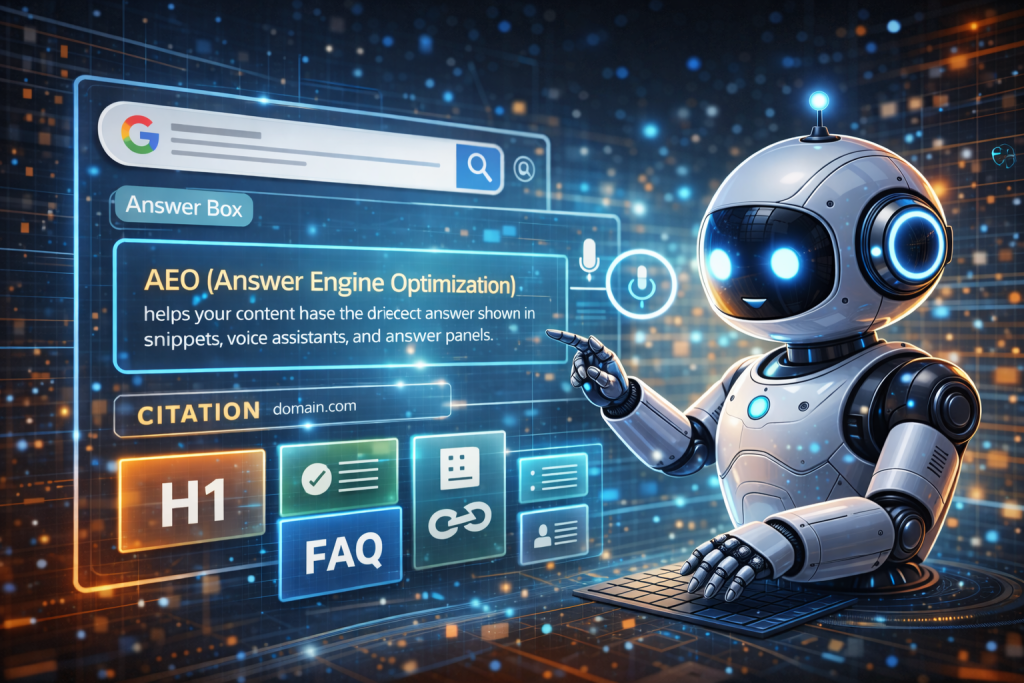
Answer Engine Optimisation (AEO) is the process of structuring content so search engines can extract it as a direct answer to a question. Instead of ranking as one of many links, your content becomes the answer displayed at the top of search results.
Example of AEO in Action
Search:
“What is artificial intelligence?”
AEO optimised content may appear as a featured snippet explaining the concept.
Example:
Artificial intelligence (AI) refers to computer systems that can perform tasks that normally require human intelligence, such as learning, problem solving and decision making.
Short, clear explanations like this are easy for search engines to extract.
Learn more here.
Why FAQs Help AEO
Frequently Asked Questions mirror how people search.
Example:
- What is SEO?
- What is AEO?
- What is GEO?
These question formats increase the chances of appearing in featured snippets.
Learn more here.
What Is GEO?
Definition
Generative Engine Optimisation (GEO) focuses on ensuring your content becomes a source used by AI systems when generating answers. Instead of ranking for clicks, GEO focuses on being cited or referenced by AI tools.
Example of GEO
User question:
“What are the best AI companies in Malaysia?”
An AI system might analyse multiple websites and generate a list of companies. Businesses included in the response have strong GEO visibility.
Read the full explanation here.
Why SEO Alone Is No Longer Enough
Many searches today are zero click searches. Users receive answers immediately without visiting a website.
Example:
- Weather forecasts
- Currency conversions
- Basic definitions
Learn more here.
Does That Mean Websites Are Becoming Less Important?
Not at all. Websites are still the source of truth for information. Think of websites like books in a library. AI tools simply summarise the information found in those books. Without the books, there would be no knowledge to summarise.
The Rise of Entity-Based SEO
Modern search engines focus heavily on entities. An entity is something clearly defined.
Examples include:
- companies
- people
- products
- technologies
Entity-based SEO helps search engines understand relationships between these concepts.
Learn more here.
Example of Entity Relationships
Consider this statement:
Black Dash Interactive Design is an AI development company in Malaysia.
Search engines recognise several entities:
Company → Black Dash Interactive Design
Industry → AI development
Location → Malaysia
Clear entity definitions help search engines understand your business.
How to Structure a Website for AI Search
AI systems analyse websites differently from humans. Instead of visual design, they interpret:
- headings
- relationships between topics
- structured data
- internal links
Learn the full strategy here.
Example of Schema Markup
Schema markup helps machines understand your content.
					{
 "@context": "https://schema.org",
 "@type": "Article",
 "headline": "SEO vs AEO vs GEO Guide",
 "author": {
 "@type": "Person",
 "name": "Edwin Yin"
 }
}
This structured data provides additional context for search engines.
The Importance of Case Studies
AI systems prefer evidence based content. Case studies show real examples.
Example structure:
- Client: Logistics company
- Problem: Manual invoice processing
- Solution: AI automation system
- Result: 70% reduction in manual work
Learn how to write AI ready case studies here.
Authority Signals
Authority signals indicate credibility.
Examples include:
- backlinks
- expert articles
- research
- industry mentions
Learn more here.
AI Visibility Strategy
Businesses should think of digital visibility in three layers.
- Layer 1: SEO for search rankings
- Layer 2: AEO for answer extraction
- Layer 3: GEO for AI citations
Learn more here.
The Future of Search
Search will likely evolve into a hybrid model that includes:
- traditional search results
- answer engines
- AI generated responses
Businesses that optimise for all three will have the strongest visibility.
Conclusion
Search is shifting from a system that lists links to one that generates answers.
To stay visible, businesses must optimise for:
- SEO — ranking in search engines
- AEO — appearing as the direct answer
- GEO — being cited by AI systems
Websites remain the foundation of digital authority. They provide the structured knowledge that both humans and AI rely on. Businesses that adapt early will gain a significant advantage in the AI-driven future of search.
How We Can Help
At Black Dash Interactive Design, we help businesses adapt to AI-first search by building AI-ready websites and content systems that go beyond traditional SEO.
Our Expertise Includes:
- AI Visibility Engineering (SEO + AEO + GEO) – Architecting websites and content for rankings, answer boxes, and AI citations.
- Custom AI Agents & Automation – Practical AI solutions that improve internal efficiency and customer engagement.
- E-commerce & Web Solutions – High-performance platforms designed for speed, structure, and conversion.
- Custom Software Development – Tailored systems built around your workflows and data.
Contact Us today to future-proof your business for the next era of search and discovery.