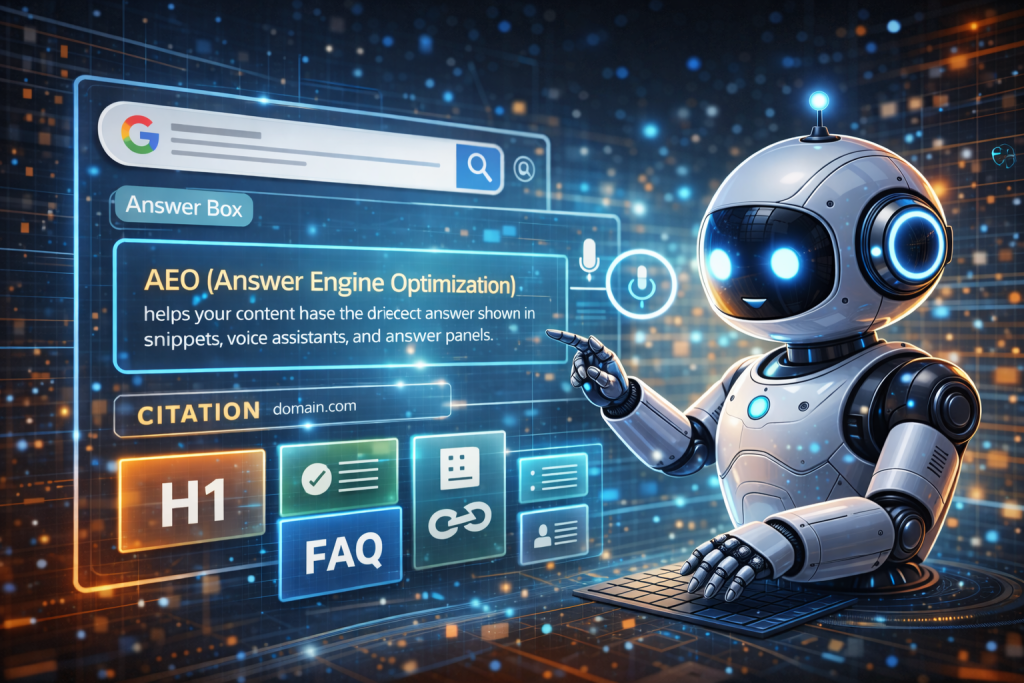
Why Website Structure Matters
Many websites are designed mainly for human visitors. But today, websites must also be understandable to machines.
AI systems analyse:
- headings
- relationships between topics
- structured data
- internal links
If your content is not organised clearly, AI systems may struggle to understand it.
To understand how this affects search visibility, read:
SEO vs AEO vs GEO: The Complete Guide to AI Search Optimisation (2026)
A Simple Metaphor
Think of your website like a library. If books are placed randomly on the floor, finding information becomes difficult. But if the library is organised with categories, shelves and labels, anyone can quickly find what they need. Website structure works the same way.
The 4 Key Elements of AI Friendly Websites
1. Clear Heading Structure
Every page should have:
- 1 H1 heading
- Multiple H2 headings
- Optional H3 headings
Example:
- H1: What Is Generative Engine Optimisation
- H2: Why GEO Matters
- H2: How GEO Works
- H2: GEO Strategy
This helps AI understand the hierarchy of information.
2. Internal Linking
Internal links connect related articles.
Example cluster:
- SEO vs AEO vs GEO: The Complete Guide to AI Search Optimisation (2026)
- What Is Generative Engine Optimisation (GEO)? The Future of AI Search
- What Is Answer Engine Optimisation (AEO)? A Simple Guide for Businesses
This tells search engines these articles belong to the same topic.
3. Semantic Content Sections
AI prefers content organised into sections such as:
- Definition
- Explanation
- Examples
- FAQ
Example:
What Is SEO
SEO is the process of improving a website’s visibility in search engines so it attracts organic traffic.
4. Structured Data
Structured data helps search engines interpret content.
Example of Article schema
					{
 "@context": "https://schema.org",
 "@type": "Article",
 "headline": "What Is Generative Engine Optimisation",
 "author": {
    "@type": "Person",
    "name": "Edwin Yin"
  }
}
This gives machines more context about the article.
Final Thought
A well structured website improves both:
- Human readability
- Machine understanding
This increases the likelihood that your content will appear in:
- Search results
- Featured snippets
- AI generated answers
To see how all these concepts connect together, read our complete guide:
SEO vs AEO vs GEO: The Complete Guide to AI Search Optimisation (2026)
How We Can Help
At Black Dash Interactive Design, we help businesses adapt to AI-first search by building AI-ready websites and content systems that go beyond traditional SEO.
Our Expertise Includes:
- AI Visibility Engineering (SEO + AEO + GEO) – Architecting websites and content for rankings, answer boxes, and AI citations.
- Custom AI Agents & Automation – Practical AI solutions that improve internal efficiency and customer engagement.
- E-commerce & Web Solutions – High-performance platforms designed for speed, structure, and conversion.
- Custom Software Development – Tailored systems built around your workflows and data.
Contact Us today to future-proof your business for the next era of search and discovery.